A Listening Hour Built Around One Instrument
A listening hour built around one instrument helps you hear changing musical roles, timbre, and texture without turning a quiet session into homework.
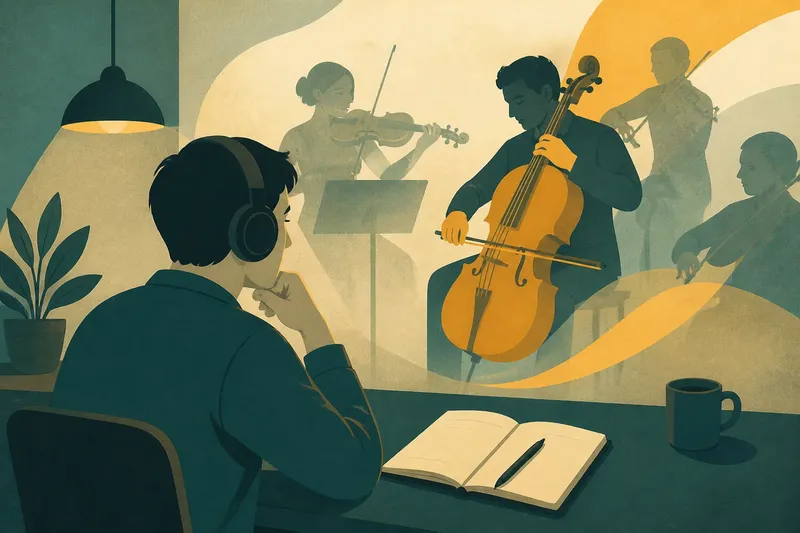
You put on a string quartet, decide to follow the cello, and lose it as soon as the violins take over. A listening hour built around one instrument sounds simple until the music starts behaving like music. The cello may carry a tune, mark a pulse, blend into a chord, or disappear beneath a louder line. The point is not to keep a perfect mental transcript. It is to notice what the instrument is doing, and what changes when its job changes.
This is a listening plan, not a test of concentration. Choose a small selection of music with the same instrument in different settings, then use timbre and texture as prompts when attention slips. The session can be quiet without requiring a special room, expensive equipment, or the stillness of a museum visitor who has misplaced their coat.
Why does the instrument keep disappearing?
Usually, the instrument has not vanished. Its role has become harder to distinguish. A flute can be obvious when it plays alone and difficult to pick out when several instruments share the same register. A piano may sound like a single source in one passage and a dense field of notes in the next. Familiarity with the instrument’s general sound helps, but musical texture—the way lines and layers combine—often explains more.
Begin by listening for a role rather than a name. Is the instrument carrying a tune, answering another part, sustaining a background, supplying a pulse, or joining a larger chord? Those functions remain useful even when the exact sound is briefly obscured. You can also listen for the edges of a phrase: the entrance, the gap before the next response, or the point where a line passes to another player.
For a first session, choose one instrument you can recognize in at least one of your selections. A voice is an instrument for this purpose, as is a saxophone, harp, bassoon, or drum kit. The central idea is to hear changing responsibility: one source can become foreground, accompaniment, punctuation, or part of the shared texture without changing its identity.
What should you choose for the hour?
Choose three or four short selections, not a pile of tracks that makes the listening itself feel like filing paperwork. Look for contrast in musical setting rather than sheer variety. A solo passage beside a small ensemble, for example, gives the ear a clear comparison between exposed and blended sound. Two versions of a similar musical style may reveal changes in phrasing and articulation more clearly than an assortment chosen only for novelty.
Keep the selected instrument constant across the session. If you choose clarinet, use pieces or excerpts where the clarinet has a meaningful part in each one. A recording in which it is buried for nearly the whole duration may be interesting in another context, but it is poor material for this particular exercise. Check track notes or instrumentation listings if needed; a short, clear description can save you from spending the session trying to identify a sound by guesswork.
Use a speaker or headphones that let you hear the music comfortably at an ordinary listening level. Keep the controls simple: a playlist, the playback bar, and perhaps a notebook. Do not spend the hour adjusting equalizer settings, comparing headphone specifications, or searching for a theoretically perfect room. Those tasks can acquire the quiet authority of useful work while keeping the music at a safe distance.
Before pressing play, write down the instrument and one question: “When does it move into the foreground?” That is enough of a prompt. A second question can wait until the first selection has given you something to notice.
How can you follow a changing role without taking notes constantly?
Listen once for the broad shape. Notice when the instrument enters, whether it stays present, and what seems to happen around it. Avoid trying to record every entrance. A brief mental map—alone, joined, foreground, background—is more useful than a page of marks whose meaning you have already forgotten by the next track.
On a second pass, if the excerpt is short enough, attend to timbre. Timbre is the quality that helps distinguish one sound from another when pitch and loudness are not the whole story. Listen for whether the tone is breathy, bright, rounded, metallic, reedy, muted, or rough; for a change from smooth to sharply articulated notes; and for how the sound begins and fades. These are descriptions, not labels the instrument must earn. A single instrument can sound quite different across registers, playing techniques, and musical surroundings.
Then listen for texture. Ask whether the chosen part stands alone, doubles another line, answers it, supports a melody with repeated notes, or blends into a chord. A shift in texture can change the perceived role without a dramatic change in volume. An instrument that has been accompanying may suddenly take the tune, while the former lead settles into support.
Say you choose a bassoon and a short excerpt begins with it playing a clear, low melody. Later, a flute takes over the tune while the bassoon moves through slower notes underneath. You might jot “melody, then support” and listen again for the moment the handoff becomes audible. The expected observable result is a clearer sense of the bassoon’s changing role, not a complete account of every note.
What if the timbre is hard to describe?
Do not force a precise adjective. “Dark” and “warm” can be handy shorthand, but they do not explain exactly what you heard, and different listeners use them differently. Describe a contrast instead: the sound seems more nasal than the previous passage, its attacks are less distinct, or its notes ring longer in the mix. Comparison gives the ear a foothold without pretending that timbre comes with a tidy measuring scale.
Listen for the instrument’s behavior as well as its color. Does it sustain a note, repeat a figure, slide between pitches, strike a short accent, or break a phrase into quick notes? These actions often make the source easier to follow. If you can name the action but not the tonal quality, you still have a useful observation.
If the recording is unfamiliar, look up the instrument’s basic family only after your first pass. Knowing that a sound comes from a plucked string, a bowed string, or a wind instrument can sharpen attention, but front-loading a technical description may encourage you to listen for the description rather than the music. The ears deserve a first opinion, even if it is “brassy, maybe.”
Why does the instrument sound different from one selection to another?
The same instrument can take on different characters because its role and surroundings change. A violin sustaining a note over a quiet accompaniment may seem smooth and exposed; a violin playing short accents among several busy parts may seem pointed and percussive. Register, articulation, dynamics, room sound, recording balance, and the instruments around it all contribute to what reaches the listener.
Keep those possibilities separate when you can. “The sound became brighter” describes an impression. “The part moved into a higher register” names one audible change that may help explain it. “The instrument became more prominent” concerns its place in the mix or texture. These observations can overlap, but they are not interchangeable. A louder part is not automatically the melody, and a quiet part can still shape the music’s direction.
It can help to compare like with like: a sustained note in one selection with a sustained note in another, or a repeated rhythmic figure with a similar one. If the passages have nothing in common, contrast them broadly rather than claiming the instrument itself has changed. The playing and the musical setting are part of the sound you are hearing.
What should you do when attention wanders?
First, return at the next phrase, not by rewinding in a panic. Ask what the instrument is doing now: leading, supporting, answering, punctuating, blending, or resting. A pause in its part is also information. It may leave another line exposed or make the return feel newly prominent.
If the music stays dense, narrow the task. Follow entrances and exits only. If even that is difficult, listen for one repeated gesture, such as a short rhythmic pattern or a long note beneath the melody. You can replay a brief passage once, but repeated stopping and restarting can break the phrase into scraps. Use replay to hear a particular transition, not to punish yourself for having noticed the kettle.
When your attention repeatedly slips for the same reason, adjust the session rather than adding pressure. Choose a shorter excerpt, move to a quieter part of the room, or use a selection with fewer simultaneous lines. The aim is not uninterrupted focus. It is to find an entry point back into the sound.
How should you close the listening hour?
At the end, write three brief observations: one about timbre, one about texture, and one about the instrument’s role. For example, you might note that its tone seemed rounded in a solo passage, that it later blended with a chord, and that it changed from melody to accompaniment. Keep the wording tied to what you heard. “The instrument was beautiful” may be true, but it does not tell you what it did.
Then choose one passage to revisit on another day, ideally a moment where the instrument’s role changed. A small return can make the transition easier to hear without turning the session into a permanent assignment. If your notes are uncertain, preserve the uncertainty: “possibly answering the oboe” is more useful than a confident claim you cannot support from listening.
What do listeners often ask about this session?
Do I need to know how to read music?
No. Follow entrances, pauses, changes in prominence, and the relationship between lines by ear. A score can be useful if you already read one, but it is not required for noticing the instrument’s changing role.
Should every selection feature the same instrument in the same style?
No, but keeping the instrument constant gives the session a clear thread. A contrast in ensemble size or musical texture can help, while too many unrelated differences may make it harder to tell which change you are hearing.
Is it better to use headphones or speakers?
Use whichever lets you hear comfortably and without distraction. Headphones may make a quiet line easier to follow, while speakers can preserve a sense of the room; neither is necessary for the listening plan.
What if I cannot identify the instrument?
Follow the sound by function first: the line that repeats, answers, sustains, or marks a pulse. You can check the recording information afterward, but a session can still work when the source’s name remains uncertain.
A listening hour built around one instrument works best when the notes stay modest and the attention stays curious. The next time a familiar part seems to disappear, try listening for what replaced its role, not only for the sound you expected to hear. That small shift can turn a missed entrance into the most interesting event in the passage.