The Myth of the One Correct Way to Read a Poem
Read a poem without hunting for one correct answer: use its sound, line breaks, images, and ambiguities to build several attentive interpretations.
You read a poem twice, circle a strange image, and still cannot tell what it “means.” The one correct way to read a poem can seem like a hidden answer key: somewhere, apparently, the poet has left a small door marked SOLUTION. A more useful approach is to treat meaning as something the poem’s choices support, not a password waiting to be guessed.
That does not mean every interpretation fits. A reading should answer to the words on the page, including their sounds, breaks, repetitions, and images. The aim is not to settle the poem forever, but to notice what it lets you see and what it makes difficult to claim.
How do you begin reading a poem without deciding too soon?
Start by reading the poem straight through, without stopping to translate each line. Notice your first response: a mood, a scene, a moment of confusion, or a word that seems oddly placed. Keep that response provisional. First impressions are useful evidence about your encounter with the poem, not instructions from the poet.
Read it again at a measured pace. This time, attend to what is actually present: who appears to be speaking, what seems to happen, and what the poem asks you to picture. If the speaker says “I,” do not immediately assume the speaker is the poet. The voice may be a created persona, a partial version of the self, or a voice whose circumstances the poem leaves open.
Make a few plain observations before offering an interpretation. “The speaker addresses someone absent” is an observation; “the poem is about bereavement” is a possible interpretation. Separating the two gives you room to change your mind without pretending the first reading was foolish. It was a reading, not a signed confession.
What do a poem’s sounds tell you?
Read the poem aloud, or quietly move your lips if the setting calls for discretion. Listen for repeated consonants, long or clipped vowels, rhyme, internal echoes, and changes in pace. You need not name every device. Ask instead what the sound encourages you to hear: a line might stumble, soften, gather speed, or seem to close firmly.
Sound can complicate a statement rather than decorate it. A speaker may describe calm in a line crowded with hard, abrupt syllables. That friction supports a reading of strained composure, but it does not prove the speaker is lying. The poem may be making calm feel difficult, or simply giving the language a texture that resists the claim.
Notice where your voice naturally pauses, then compare that pause with the punctuation. A comma may ask for a small turn; a period may shut one thought before another begins. A lack of punctuation can leave the voice suspended between possibilities. These are invitations to listen, not commands to perform the poem with theatrical weather.
How should you read line breaks?
Read each sentence once as a sentence, following its grammar across the line endings. Then read it again with attention to where the poem makes your eye stop. A line break can hold a word at the edge of a thought, delay a completion, or make a phrase briefly look as if it belongs with what came before.
For instance, if a line ends with “the last light” and the next begins “leaves the room,” the break may briefly make “the last light” feel like a subject or object held on its own. When the sentence continues, you revise your first sense. That small adjustment is part of reading, not a mistake to correct.
Do not treat every break as a coded message. Some breaks shape the page, regulate breath, or establish a rhythm that becomes clearer across several lines. Look for patterns: do lines repeatedly break before a verb, separate a description from its subject, or interrupt a sentence at a moment of uncertainty? A recurring choice offers more to work with than one isolated line ending.
What can an image support—and what can’t it settle?
Take an image literally before turning it into a symbol. If a poem mentions a window, notice what it does in the scene: lets in light, frames a view, reflects a face, or separates someone from the outside. Then ask what those details might suggest in context. A window could support readings about access, distance, exposure, or simply the room’s physical setting.
Images gain force through their neighbors. A bird beside a locked gate may feel different from a bird beside open water; neither arrangement automatically supplies a universal meaning for “bird.” Track how the image changes as the poem develops. Does it return, become less stable, or acquire a quality it did not have at first?
Be wary of symbolic dictionaries that assign one fixed meaning to every object. A rose can carry associations of beauty, desire, or fragility, but the poem may use it as a garden detail, an unwanted gift, or a bright color against a dull room. The words around the image matter more than a general rule carried in from elsewhere.
How can you build more than one attentive reading?
Once you have observations, form two interpretations that differ in a meaningful way. Keep each tied to evidence. One might emphasize the speaker’s longing; another might emphasize the limits of what the speaker can know. Then ask what each reading explains well and where it has to strain.
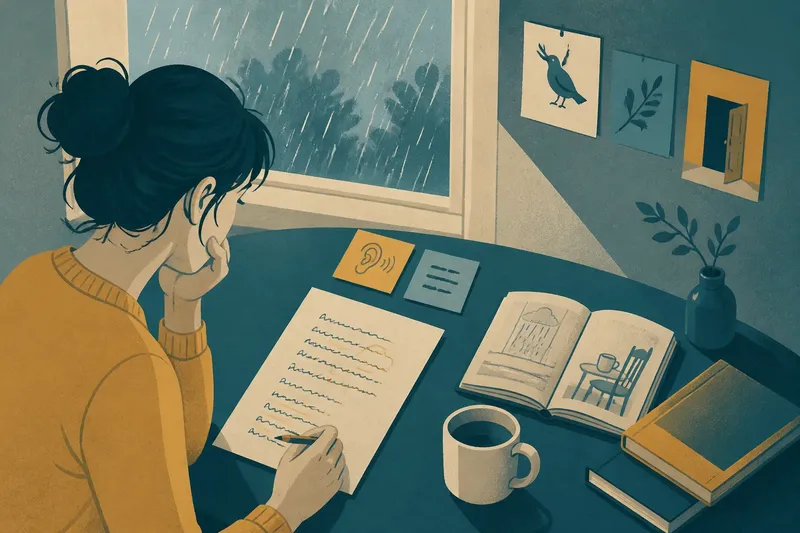
Say you read an invented poem in which a speaker watches rain stripe a kitchen window while setting an untouched cup across from an empty chair. The speaker calls the room “peaceful,” but the lines repeatedly break before words associated with waiting. You might read the scene as a chosen solitude, with the untouched cup marking a quiet domestic routine; or as an absence the speaker cannot name, with “peaceful” sounding more like an effort than a settled fact. The rain, chair, cup, and breaks can support both readings. Neither makes the other disappear.
Useful interpretations may overlap. A poem can present solitude as both relief and loss, or let a speaker sound certain while exposing the limits of that certainty. Rather than forcing a single verdict, ask what the poem permits you to hold together. Ambivalence is not a failure to understand; sometimes it is the shape of what the poem understands.
What questions help you test a reading?
Who is speaking, and what can they know?
Identify the speaker’s apparent position, audience, and limits of knowledge. If the poem withholds a name or backstory, do not fill the gap as though it were a blank in a form.
Which words change the tone?
Look for a shift in diction, rhythm, or address, especially where the poem moves from description to judgment. A change may complicate the speaker’s earlier confidence without canceling it.
What happens at the ending?
Check whether the final lines resolve an image, redirect it, or leave the sentence open. An ending can narrow a reading, but it need not hand down a verdict on every earlier detail.
What evidence would challenge your interpretation?
Find a phrase, sound, or image your preferred reading handles badly. If another interpretation explains that detail more naturally, revise your claim rather than asking the poem to ignore it.
How do you talk about a poem without claiming the answer?
Use language that shows the difference between evidence and inference. “The repeated soft sounds make the line feel hushed to me” is more precise than “the poet wants us to feel peaceful.” “The empty chair suggests an absence” leaves room for the poem’s other details; “the chair represents death” makes a much larger claim and needs stronger support.
When discussing a poem with someone else, compare what each reading notices. One reader may be attending to the image, another to the line break, and both may be right about different pressures in the poem. Disagreement becomes useful when it sends you back to the text instead of turning into a contest over who can sound most certain.
What is not worth the effort? Trying to decode every comma as a private signal, or searching for one authorized paraphrase that makes the poem stop moving. A plain paraphrase can help you locate the scene, but it cannot replace the work done by rhythm, ambiguity, and arrangement.
To read a poem without assuming one correct answer, return to the page with a better question: what does this detail make possible, and what does it resist? That question keeps interpretation accountable to the poem while leaving room for its several attentive readings. You do not need to solve the poem before you are allowed to hear it.