Before the Gallery Wall: Pictures in the Cabinet of Curiosities
Pictures in the cabinet of curiosities shared space with shells and instruments. Learn how mixed displays shape attention and change the way pictures are read.
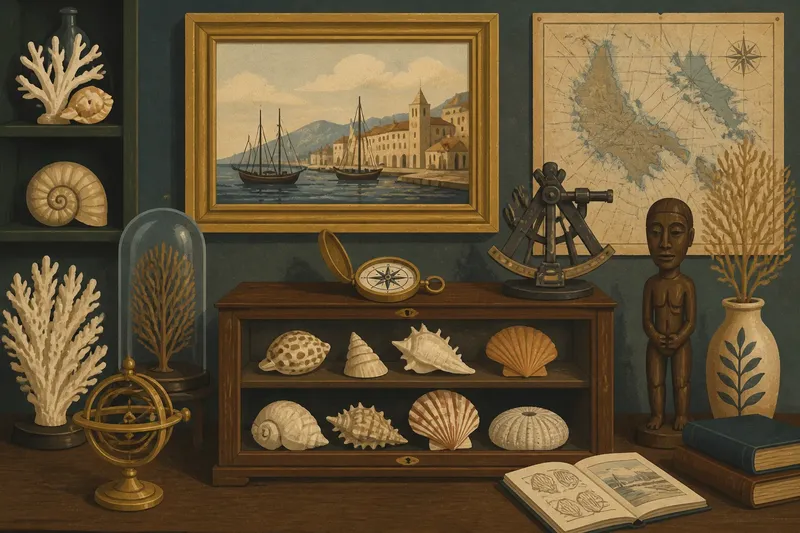
A visitor enters a collector’s room and finds a painted portrait above a cabinet of shells, a map beside a metal instrument, and a carved figure near a dried plant. Pictures in the cabinet of curiosities did not usually command a bare wall of their own. They belonged to a room where objects were gathered, compared, and displayed as parts of a larger picture of the world.
To understand that arrangement, notice its mix, consider how the objects relate, and compare the experience with a dedicated gallery. A short routine can make those observations manageable without turning the visit into a historical reenactment.
What made a collecting room different from a gallery?
A cabinet of curiosities, also called a cabinet or collection room, was a place where a collector brought together objects valued for their rarity, beauty, strangeness, craft, or capacity to explain something. “Cabinet” could refer to a piece of furniture, a collection, or the room that housed it. The room might contain natural specimens, antiquities, scientific instruments, books, artworks, and objects made far from home.
Pictures were part of that company. A painting, drawing, print, or map could sit among three-dimensional things rather than occupy a sequence of walls devoted mainly to pictures. The arrangement might reflect available space, the collector’s interests, or a desire to show the breadth of a collection. It did not have to follow the modern expectation that each artwork should be isolated and given a clearly bounded field of attention.
A dedicated gallery tends to make pictures the main event. The wall, spacing, lighting, and route through the room can direct attention toward one work at a time or toward deliberate groupings. A collecting room asks for broader looking: the picture remains important, but its neighbors also shape the display’s meaning.
What should you notice first in a mixed display?
Begin with the room as a whole. Notice where pictures appear, how high they hang, and whether they are grouped tightly or separated by shelves, cabinets, or furnishings. Then look for the non-picture objects that share their immediate space. A shell beside a painted study, for instance, may invite a comparison between observing nature and representing it on paper, whether or not the collector intended a precise argument.
Next, ask what relationships the arrangement makes visible. Look for contrasts in scale, material, subject, and apparent purpose. A finely worked instrument near a portrait brings measurement and likeness into the same field of view. A map among landscapes might make geography feel less like a separate subject than another way of representing the world.
Keep the distinction between what you can see and what you infer. The arrangement may support a comparison without revealing exactly why the collector placed two things together. Provenance records, collection catalogues, and surviving room descriptions can clarify some choices, but a visual pairing alone is not a signed explanation.
How can you follow a week of looking?
Use five short sessions across one week: one session on each day that suits your schedule, with a day or two between visits if convenient. You can make them separate museum visits, or divide a single visit into five pauses. The point is to return to the same display with a different question, not to keep a strict calendar.
- Session one: take in the room. Stand where you can see the overall arrangement. Check how densely objects are displayed and where pictures appear. If one picture immediately dominates, note what draws your eye; if no picture stands out, begin with a broad view instead.
- Session two: follow the pictures. Trace where paintings, prints, maps, or drawings are placed. If several share a subject, frame, or position, compare that grouping; if they do not, note which non-art objects sit closest to them.
- Session three: follow one object. Choose a shell, tool, specimen, or crafted object and check which pictures are visible from its position. If one nearby image gains a new association, record the connection; if none does, note that the object may simply share the room.
- Session four: compare materials and purposes. Put a painted surface beside a natural specimen or manufactured instrument in your attention. If their different materials suggest distinct ways of observing or recording, describe the contrast; if the relationship remains unclear, leave it open rather than inventing a purpose.
- Session five: revisit one pairing. Return to a picture and its nearest object. If the relationship still seems meaningful, state what visible details support that reading; if it now seems practical or uncertain, keep that as your answer.
Say you have five sessions available during one week and find a small harbor painting above a cabinet holding shells and a brass compass. In the first session, you note that the painting shares the room with many objects. In the second, you trace the pictures and see that the harbor scene is not grouped with other landscapes. In the third, you look from the shells and compass back to the painting; the compass’s directional markings make the harbor subject feel connected to locating a place. In the fourth, you compare painted water with the shells’ surfaces and the compass’s metal construction, noting that each presents a different kind of evidence about the world. In the fifth, you return to the pairing and decide that the connection is suggestive but not proof of a deliberate message. The resulting interpretation is specific, and its uncertainty is visible.
Do not turn the routine into an inventory contest. Trying to record every object, read every label, and settle every historical question in one sitting is not worth the effort. A few observed relationships are more useful than a notebook full of names you cannot place.
Why do dedicated galleries feel different?
In a dedicated gallery, separation can make comparison easier within a narrower field. Several portraits may reveal changes in pose, format, or treatment of a face. A room of prints can encourage attention to line, paper, and differences between impressions. The display helps establish what to compare by making the works’ shared medium or subject prominent.
A mixed collecting room widens the field. The picture may be read alongside an object from another category, so attention moves between ways of representing, collecting, and knowing. That movement can make connections vivid, but it can also make a single work harder to isolate. The room offers relationships while withholding the quiet perimeter a modern gallery wall often provides.
Neither arrangement is a neutral container. A gallery’s spacing and grouping shape what counts as a useful comparison; a cabinet room’s abundance does the same through proximity and variety. Each organizes attention differently.
What questions help you read the room?
Were pictures always hung close together?
No single arrangement describes every collecting room. Pictures could be hung in close groups, mixed with objects and furniture, or distributed according to the room’s available surfaces and the collector’s preferences.
Did every object have a scientific purpose?
No. Collections could bring together objects for beauty, rarity, craft, curiosity, study, or several reasons at once. A modern category such as “scientific specimen” may not capture the full interest an object held for its owner.
How can I tell what an arrangement meant?
Start with visible relationships, then consult labels or collection information for historical context. Treat proximity as something to investigate, not proof that the collector intended a particular symbolic pairing.
Does a crowded room make pictures less important?
Not necessarily. A picture could be valued highly while sharing its setting with other prized objects. Its importance may be expressed through its subject, materials, framing, or place within the collection rather than by empty wall space.
What does the room teach about looking?
Pictures in the cabinet of curiosities make the act of viewing less solitary. A work enters a network of neighbors: a specimen can sharpen attention to painted detail, while a map or instrument can make a picture’s subject feel newly connected to place or observation. The result depends on the particular room, so general claims should stay modest.
When you next encounter a mixed display, let the picture keep its own identity while noticing what shares its space. That double attention offers a practical way to understand why collecting rooms and dedicated galleries can make the same picture feel like two different kinds of encounter.